Quick answer.
Semaglutide and tirzepatide are injected under the skin once a week, into the abdomen, the front of the thigh, or the back of the upper arm. Pick a new spot each time, at least an inch from the last and two inches from the navel. Any time of day works, with or without food. If yours comes as a vial and syringe rather than a pen, the dose on the pharmacy label is the only number that matters — measure it exactly, and ask before you guess.
The FDA labels for Wegovy (semaglutide) and Zepbound (tirzepatide) name the same three sites and the same once-weekly schedule, and both allow dosing at any time of day with or without meals. If cost is part of your decision, the free GLP-1 cost calculator turns a monthly price into cost per pound.
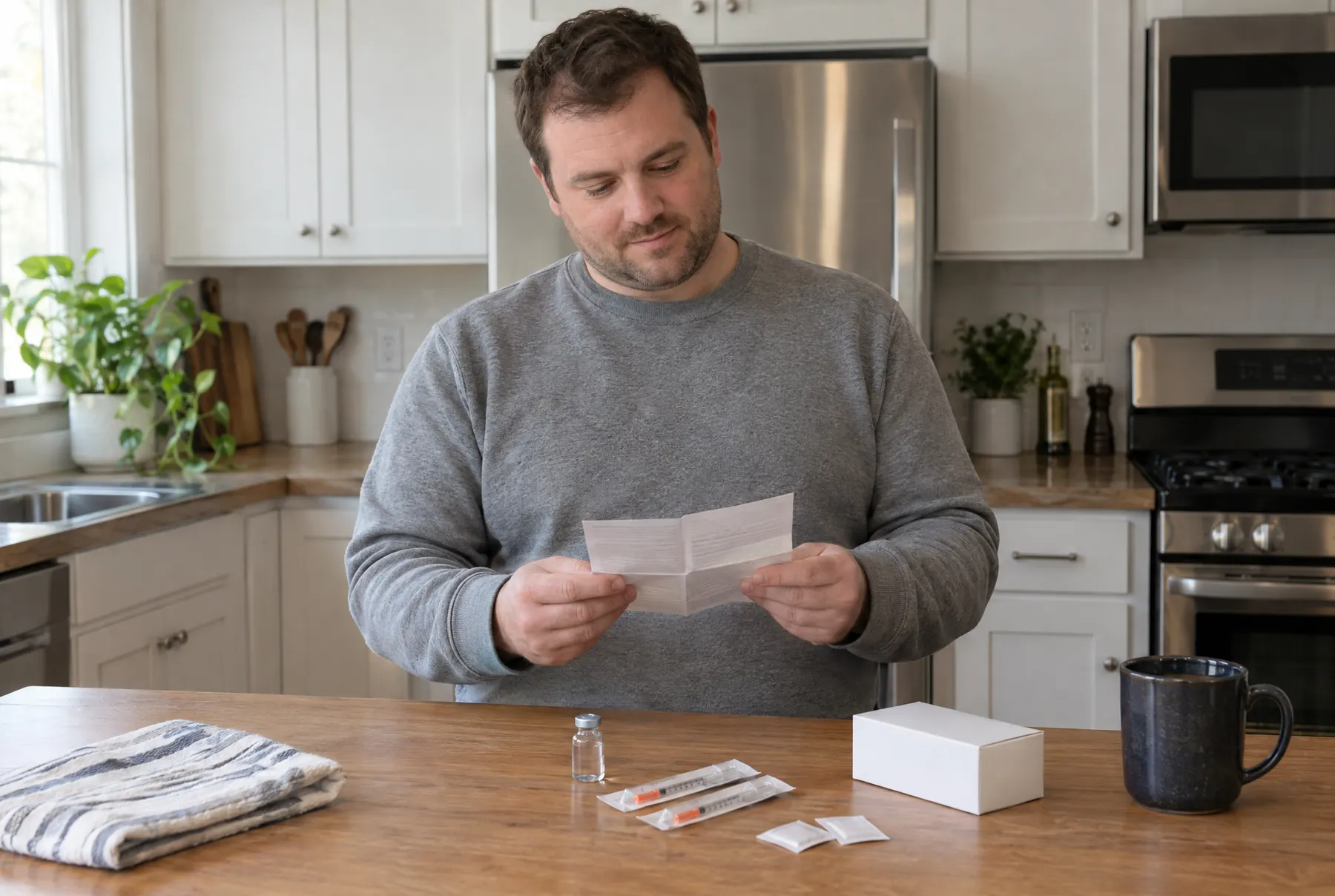
The box arrives. Inside is either a pen that looks like it was designed by someone who cares about you, or a small glass vial, a bag of syringes, and an instruction card that assumes you already know what you are doing. Most people starting a GLP-1 get the second one, because most people starting a GLP-1 in the United States right now are starting a compounded version.
The injection is not hard. A short, thin needle into fat, once a week, takes about four seconds. What trips people up is the part around it: where to put it, how to measure it, what to do when the weekly day lands on a wedding, and whether the little red dot afterward is normal. This is a walk through all of that, in the order you will actually need it.
One rule before anything else. Your pharmacy label and the clinician who prescribed it set the dose. This article does not, and nothing here should be read as a dosing instruction.
Where to inject semaglutide and tirzepatide
Both medications go into the fat layer just under the skin, in one of three places: the abdomen, the front of the thigh, or the back of the upper arm. Those are the sites listed on the FDA labels for both Wegovy and Zepbound, and compounded semaglutide and tirzepatide are given the same way.
The abdomen is the easiest for most people because you can see what you are doing and there is usually enough fat to pinch. Stay at least two inches away from the navel, below the ribs and above the hip bones. The thigh works well if you prefer to sit; use the outer front, not the inner side. The back of the upper arm is awkward to reach on your own, which is why the labels describe it as the site to use when someone else is giving the injection.
Skin matters more than the site. Do not inject into anything bruised, scarred, red, swollen, or tender. Rotating is not optional: move at least an inch from the last spot every week. Hitting the same patch repeatedly is the most common reason people develop lumps, and it can change how the medication absorbs. Some people keep a simple mental grid — left abdomen this week, right abdomen next, then thighs — which is all the system you need.
Pen vs vial and syringe: what changes
A brand-name pen has the dose pre-set. You turn a dial or press a button, hold, and you are done. A compounded prescription usually comes as a multi-dose vial and a pack of small insulin-style syringes, and the dose has to be drawn up by you, every week, correctly.
This is where the real risk lives. The FDA has received reports of people being hospitalized after measuring the wrong dose of compounded semaglutide — in some cases patients drew up too much, and in others a clinician miscalculated. The same page notes that some compounders sell semaglutide in salt forms the agency says it has no lawful basis to approve for compounding, and that adverse reports for compounded GLP-1s are probably undercounted. None of that means compounded medication is unsafe by default. It means the measuring step deserves the attention a pen would have handled for you.
Three things prevent almost all of it. First, know whether your label is written in units, milliliters, or milligrams, and do not convert between them in your head. Second, if the number on the label does not match what the syringe markings seem to show, stop and call the pharmacy before injecting anything. Third, use a new sterile syringe and needle every single time — the vial is a multi-dose container, and the needle is not.
The injection, step by step
The sequence is the same every week, and after the third or fourth time it stops feeling like a procedure. The NIH's MedlinePlus guide to subcutaneous injections is the clearest public reference for the technique, and this follows it.
Wash your hands with soap for a full minute and dry them on a clean towel. Check the label: right medication, right dose, not expired, liquid clear. Take the vial out of the fridge about fifteen minutes before you plan to inject; cold medication stings more than room-temperature medication, and that is most of what people mean when they say the shot hurts.
Wipe the vial top with an alcohol pad. Draw up the dose exactly as the pharmacy showed you, tap out any large air bubbles, and set the syringe down somewhere clean. Wipe the injection site with a fresh alcohol pad in an outward spiral and let it air-dry — injecting through wet alcohol is the second reason shots sting.
Pinch about an inch of skin and fat between thumb and forefinger. Insert the needle quickly at 90 degrees — straight in — or at 45 degrees if you are lean enough that there is not much to pinch. Let go of the skin, push the plunger steadily until the syringe is empty, and pull the needle straight out. Press a piece of clean gauze on the spot for a few seconds. Do not rub. Drop the syringe, needle still attached, into a sharps container without recapping it.
That is the whole thing. A pen skips the draw-up step and most pens want you to hold the button down for a count of ten after the click; your pen's own leaflet overrides anything general.
When to inject: day, time, and food
Both medications are once-weekly, on the same day each week, at any time of day, with or without food. There is no clinical reason to inject in the morning versus the evening, and no reason to inject on an empty stomach. The label allows you to change your weekly day as long as the gap between doses stays at least two days.
Practically, two patterns work. Some people inject the evening before a quiet day, so if nausea shows up it lands on a Saturday rather than a Tuesday morning meeting. Others inject in the morning so they can eat lightly and see how they feel. Either is fine. Consistency matters more than the clock.
Missed doses have a label rule. If you forget and the next scheduled dose is still more than two days away, take the missed dose as soon as you remember and carry on with your usual day. If the next dose is less than two days away, skip the missed one and resume on schedule — do not double up. If you have missed two or more doses in a row, that is a conversation with your clinician, because the label may call for restarting the dose escalation rather than jumping back to where you were.
Storage and handling
Keep the vial or pen in the refrigerator, not the door, and not touching the cooling element at the back. Do not freeze it, and do not use it if it has been frozen. Keep it out of direct light. If a shipment arrives warm — the FDA's guidance is explicit on this — do not use it; call the pharmacy.
Multi-dose vials have a clock. The FDA advises discarding a compounded GLP-1 vial 28 days after the first puncture even if medication remains, because every needle stick is a chance for contamination and the preservative has limits. Write the date you first opened it on the vial with a marker. If your pharmacy's label gives a different in-use window, the pharmacy's label wins.
Traveling is easier than people expect. A small insulated pouch with a cold pack keeps the medication within range for a day. Keep it in your carry-on, not checked luggage, and bring the pharmacy label in case anyone asks about the syringes. If you are a Maro patient, the pharmacy that ships your prescription is named on the GLP-1 page, and its label is the one to follow.
Find out if this is right for you.
The Maro intake takes about five minutes. A licensed physician reviews your case before any prescription is issued — no rubber stamps.
Start My Free VisitThe mistakes that actually matter
Most mistakes are harmless. A few are not, and the difference is worth knowing.
Reusing a needle is the one that matters most. A used needle is dull, bent at the tip, and no longer sterile — it hurts more, bruises more, and raises infection risk every time. Syringes are cheap; ask the pharmacy for more if you run low. Injecting into the same spot week after week is the second: it causes hard lumps of fat tissue that can slow absorption and are difficult to get rid of once they form. Injecting cold medication through wet alcohol is the third, and it is the reason most people who say the shot hurts are hurting themselves unnecessarily.
Measuring is in a category of its own. If you are ever unsure whether you drew up the right amount, do not inject it. Push it back into the vial, call the pharmacy, and wait. A missed day is recoverable. An overdose is a trip to the emergency department.
And the things that are not mistakes: a drop of blood, a small bruise, a brief sting, a pea-sized bump that fades in a day or two. Those are what injecting into skin looks like.
Does it hurt? Injection-site reactions
Usually not much. The needles used for subcutaneous injection are short and thin, and most people describe the sensation as a brief pinch. In the Zepbound trials, injection-site reactions — redness, itching, or a small lump at the site — were reported by 6 to 8 percent of people on the medication versus 2 percent on placebo. They tend to be mild and to settle within a few days.
Reactions that are not normal: spreading redness, warmth, red streaks running away from the site, pus, or a fever. Those are signs of infection and need a clinician the same day. Hives, swelling of the face or throat, or trouble breathing after an injection are an emergency.
When to talk to a clinician
Talk to a clinician if you have missed two or more doses, if you are unsure how to measure your dose, if an injection site shows signs of infection, if nausea or vomiting is severe enough that you cannot keep fluids down, or if you are not sure whether what arrived is what you were prescribed. Any of those is a reason to pause rather than push through.
Most of the week-to-week questions — which site, which day, what to do about a small bruise — are answered above and do not need a visit. If you have not started yet and are weighing the two medications, our comparison of tirzepatide and semaglutide covers how they differ, and the cost breakdown covers what a monthly price should include.
Frequently asked questions
Where is the best place to inject semaglutide or tirzepatide?
The abdomen, the front of the thigh, or the back of the upper arm — the three sites named on the FDA labels for both medications. The abdomen is easiest for most people because it is visible and has enough fat to pinch; stay at least two inches from the navel. Rotate to a new spot at least an inch away each week.
Can I inject semaglutide or tirzepatide at any time of day?
Yes. Both labels allow once-weekly dosing at any time of day, with or without food. Pick a day and roughly a time you can keep, because consistency matters more than the clock. You can change your weekly day as long as at least two days pass between doses.
What happens if I miss a dose?
If the next scheduled dose is more than two days away, take the missed dose as soon as you remember. If it is less than two days away, skip it and resume on your normal day — never double up. If you have missed two or more doses in a row, talk to your clinician before restarting, because the dose may need to be stepped back up.
Do I need a new needle every time?
Yes. A used needle is dull, no longer sterile, and more painful. Use a new sterile syringe and needle for every injection and drop the used one into a sharps container without recapping it. If you are running low, ask the pharmacy for more.
How long can a compounded vial be used after opening?
The FDA advises discarding a compounded GLP-1 multi-dose vial 28 days after the first puncture, even if medication remains. Write the date you opened it on the vial. If your pharmacy label gives a different in-use period, follow the pharmacy label.
Researched and written by The Maro Care Team and reviewed by a licensed physician through our clinical partner network. Maro provides telehealth care for men and women across GLP-1 weight loss and performance, plus hair loss and ED treatment for men. Last reviewed: October 2026.